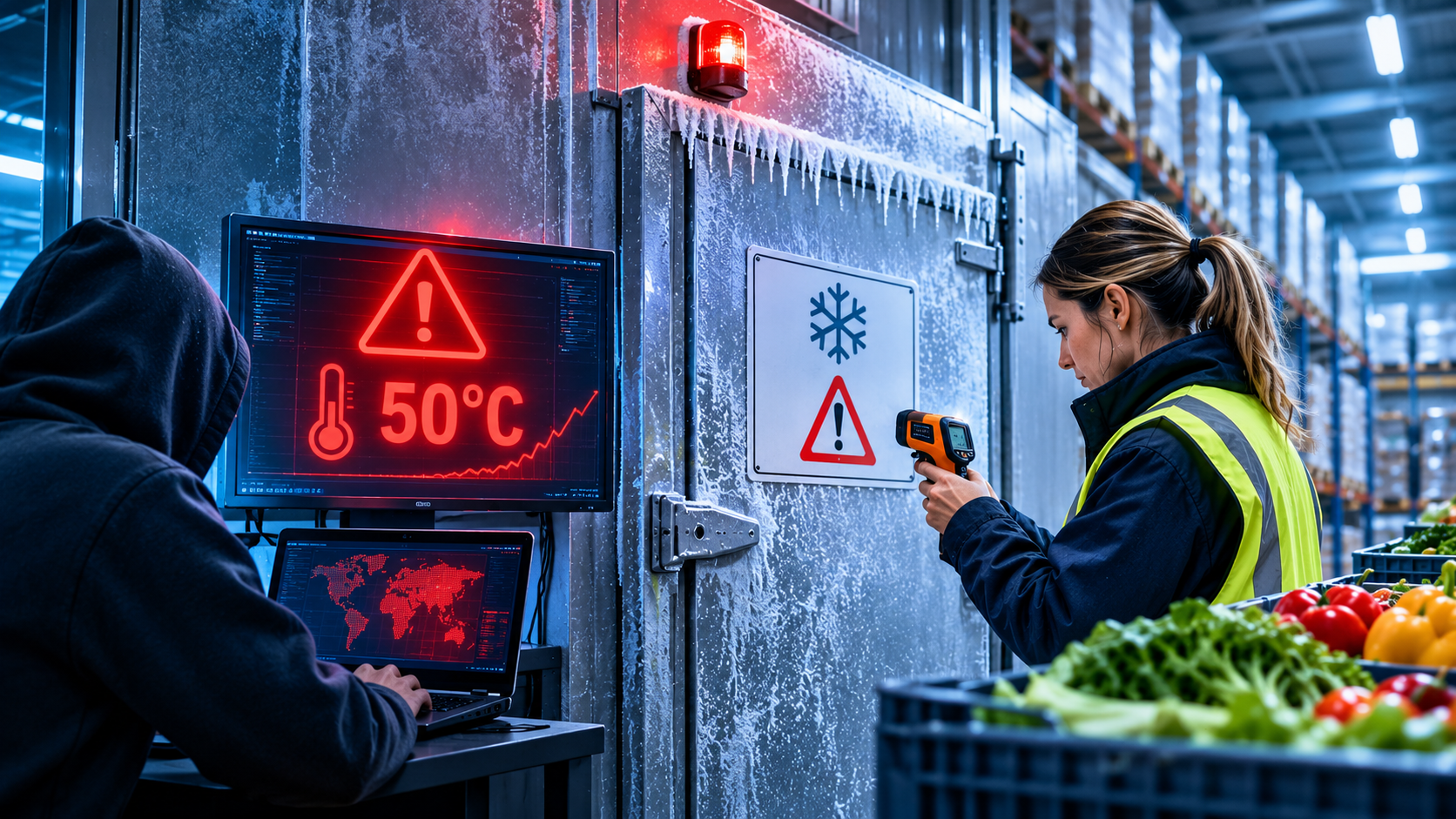

What hacked refrigeration systems tell us about risk, resilience and the outcomes that really matter.
There’s something almost ridiculous about the idea of a freezer being hacked. Until you consider what happens when digital vulnerabilities become very physical consequences. Across Europe, hackers have manipulated connected refrigeration systems, sending temperatures as high as 50°C and leaving stores with spoiled food and empty shelves.[1]
But perhaps the most interesting story is about the stock that wasn’t lost. At Langridge Organic, a West London fresh-food wholesaler, hackers reportedly compromised six of ten cold-room control systems[2]. They triggered defrost cycles and disabled the automated temperature alerts. Yet no stock was lost.
Why? Because employees carried out regular manual checks, spotted the problem and intervened, disconnecting the affected equipment from the internet. The technology failed, but the people and independent checks didn’t.
That’s what makes this more than another cybersecurity story; it’s a very tangible lesson in resilience. We tend to put incidents like this in the ‘cyber risk’ box, and of course exposed systems, outdated technology and weak access security matter. However, if our response starts and ends with patches, passwords and an updated risk register, we’ve missed the bigger point.
Supermarkets don’t exist to keep freezers running. They exist to provide safe, available food to customers.
Refrigeration is a critical dependency that makes that outcome possible. When it fails, the consequences go well beyond IT: wasted stock, lost sales, operational disruption and damaged trust. This is exactly why we’ve been challenging organisations to think differently about risk and resilience. Start with the objective, understand the essential outcomes that must be delivered, and follow the golden thread through the people, processes, suppliers, technology, controls and assurance on which those outcomes depend.
Then change the question: not simply ‘Have we mitigated the cyber risk?‘ but ‘Can we still deliver what matters when a critical dependency fails?’
Think about what these attacks expose. Who knew the refrigeration controls were remotely accessible? Who was responsible for securing that access? What happens when the warning system can itself be disabled? Is there an independent way to detect failure? Can people act quickly enough to protect the outcome? And, critically, has any of this actually been tested?
A resilience plan is not the same as a resilience capability. Having controls isn’t the same as being in control and having assurance isn’t the same as being assured. Langridge Organic could easily have looked at regular manual temperature checks as an inefficiency. Why keep doing something the technology already does? But when that technology failed, those seemingly redundant checks protected the outcome. It’s a powerful reminder that resilience isn’t always about more sophisticated solutions. Sometimes it’s about knowing what not to optimise away.
There’s another lesson here. Resilience doesn’t stop at organisational boundaries. Technology vendors, maintenance contractors and external connections can create dependencies that businesses may not fully understand, let alone control. None of these challenges is new, but what’s striking is how dramatically these attacks bring them to life.
The challenge for leaders isn’t to choose between efficiency and resilience. It’s to make conscious decisions about the trade-offs. Where can we safely streamline, and where does protecting an essential outcome justify keeping an additional layer of protection? Risk management should help make those choices visible. Resilience should give leaders confidence that the organisation can still deliver when things go wrong.
Today it’s a freezer. Tomorrow it could be a production line, a hospital cooling system or a smart building. Different assets but same fundamental challenge.
If your resilience thinking ends at the risk register, you might not notice the temperature rising until the stock is gone.
[1] Reuters, 3 November 2026: European refrigeration cyberattacks.
[2] The Grocer, 3 November 2026: Langridge Organic incident.

AUTHOR.
EMMA PRICE.